Transformer manufacturers continually work to improve electrical efficiency, reduce operating temperatures and maintain consistent production quality. While electrical steel selection and core design are important, manufacturing conditions can also influence the finished transformer’s performance.
One critical factor is the quality of the cut edges on individual core laminations.
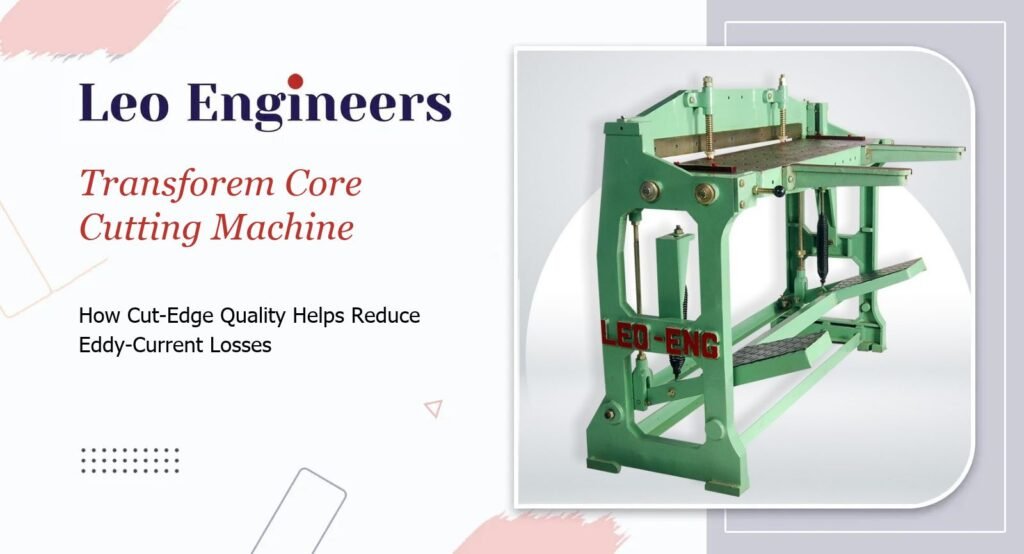
A Transformer Core Cutting Machine must produce accurately shaped electrical steel laminations while controlling burr formation and minimizing damage to the material.
Poorly controlled cutting can damage the insulating coating or create burrs that increase the risk of electrical contact between adjacent laminations.
Understanding this relationship helps transformer manufacturers identify manufacturing practices that support lower additional core losses.
1. How Eddy Currents Develop in Transformer Cores
When alternating magnetic flux passes through a transformer core, it induces circulating electrical currents within the conductive steel.
These are known as eddy currents.
The currents generate heat and contribute to the transformer’s total core losses.
Transformer manufacturers use thin, electrically insulated steel laminations to restrict these circulating currents.
Each lamination is designed to remain electrically separated from adjacent sheets.
However, damage introduced during cutting or subsequent handling can compromise this separation.
Why lamination insulation matters
The insulating coating on electrical steel helps prevent electrical contact between neighboring laminations.
If cutting produces significant burrs, the raised metal edges may penetrate or bridge the insulation between adjacent sheets.
This creates the possibility of interlaminar short circuits and additional localized losses.
Consequently, controlling cutting-related defects is an important part of manufacturing transformer cores.
2. Understanding the Relationship Between Cutting Burrs and Core Losses
Burrs are raised or displaced material that can form along a sheared edge.
Their severity depends on several factors, including material characteristics, blade geometry, blade clearance and cutting conditions.
For transformer manufacturers, burrs present two concerns.
Electrical concern: Excessive burrs can increase the risk of electrical contact between stacked laminations.
Manufacturing concern: Irregular edges can interfere with lamination stacking and affect the finished core’s assembly quality.
Controlling burr formation therefore supports both electrical performance and manufacturing consistency.
However, burr-free appearance alone does not guarantee low transformer losses. Material properties, magnetic design, insulation integrity and assembly methods also influence the finished result.
3. How Cutting Can Affect CRGO Electrical Steel
Cold-rolled grain-oriented (CRGO) electrical steel is manufactured to provide favorable magnetic properties in a specified rolling direction.
Transformer core production requires careful processing of this material.
Mechanical cutting introduces localized deformation near the sheared edges. Depending on the material and process, this deformation can influence the magnetic characteristics of the affected region.
The extent of the effect depends on the cutting method, material properties and subsequent manufacturing processes.
Manufacturers should therefore evaluate more than dimensional accuracy when assessing their lamination cutting process.
Important considerations include:
- Cut-edge condition
- Burr formation
- Localized material deformation
- Insulating coating damage
- Lamination handling
- Consistency between production batches
These factors help determine whether the cutting process is suitable for the intended transformer application.
4. The Role of Blade Material and Cutting Conditions
Blade selection influences cutting performance, edge quality and production consistency.
For electrical steel processing, the shear blade material must be suitable for the steel grade, material thickness, cutting mechanism and production requirements.
HCHCR steel is one blade-material option used in industrial cutting applications. Its suitability depends on the specific machine and processing conditions.
Hardness alone does not guarantee a superior cutting result.
Blade geometry, heat treatment, clearance and the condition of the cutting system also influence performance.
Manufacturers should follow the equipment supplier’s recommendations rather than selecting blades based on hardness alone.
5. Protecting Lamination Insulation During Production
Controlling burrs is only one part of protecting lamination insulation.
Damage can also occur during feeding, stacking, transportation and assembly.
Transformer manufacturers should establish appropriate handling procedures throughout the production process.
For example, excessive mechanical contact or poorly controlled handling can damage the insulating coating even when the initial cutting operation produces acceptable edges.
A coordinated manufacturing process should consider cutting quality and downstream material handling together.
6. Production Checks for Consistent Lamination Quality
A quality-control process helps manufacturers detect cutting-related defects before laminations enter the core assembly stage.
| Inspection area | What to examine | Manufacturing relevance |
|---|---|---|
| Cut edges | Burrs and irregularities | Helps identify potential insulation-bridging risks |
| Lamination dimensions | Length and geometry | Supports consistent core assembly |
| Insulating coating | Visible scratches or damage | Helps identify potential electrical contact risks |
| Lamination flatness | Bending or distortion | Supports consistent stacking |
| Cutting consistency | Variation between batches | Helps identify changes in processing conditions |
Inspection criteria and acceptable tolerances should be established according to the material specification, transformer design and applicable quality requirements.
7. Why Core Loss Testing Remains Essential
Visual inspection and dimensional measurements are useful manufacturing controls, but they cannot independently establish the electrical performance of a completed transformer core.
A lamination can appear acceptable while still containing localized damage that is difficult to identify visually.
Core loss testing provides additional information about the magnetic performance of the assembled core.
Manufacturers can use relevant test results alongside production inspection records to investigate whether changes in cutting conditions are associated with changes in finished-core performance.
This approach provides a stronger basis for process improvement than relying on cut-edge appearance alone.
8. What Transformer Manufacturers Should Discuss With Their Equipment Supplier
Before specifying a transformer core cutting machine, manufacturers should communicate their actual processing requirements.
These include the electrical steel grade, lamination thickness, required cutting geometry, production volume and applicable quality tolerances.
Manufacturers should also discuss how the proposed machine and its cutting system address edge quality, material handling and repeatability.
Machine-specific performance figures should be supported by technical documentation or appropriate production trials.
The objective is to establish a cutting process that meets both the mechanical and electrical requirements of the intended transformer core.
Conclusion
Precision transformer core manufacturing requires more than producing laminations of the correct dimensions.
Cut-edge quality, insulation integrity and careful material handling can influence the electrical performance of the finished core.
By controlling burr formation and protecting the insulating coating, manufacturers can reduce the risk of cutting-related defects that contribute to additional eddy-current losses.
Leo Engineers provides industrial machinery solutions. Manufacturers evaluating transformer core cutting equipment can contact the team to discuss their material specifications, cutting requirements and production objectives.