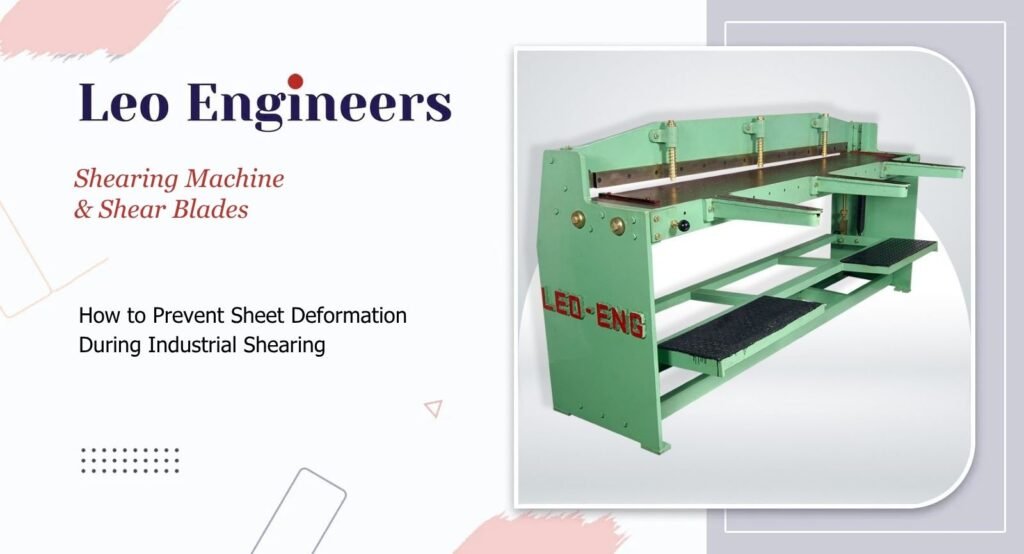
Sheet shearing looks straightforward: position the sheet, engage the cutting mechanism, and produce the required blank. But in actual fabrication work, the cut itself is only part of the result.
A sheet can have the correct dimensions and still create problems if it comes out bent, twisted, curled, bowed, or distorted around the cut edge.
These problems become more noticeable when working with long sheets, thin gauges, stainless steel, cold-rolled sheets, or components that require accurate downstream forming.
This is why understanding sheet deformation during shearing is important for fabrication workshops and industrial production units.
The good news is that many deformation problems can be reduced by controlling the material, machine setup, blade condition, clearance, support, and cutting method.
What Is Sheet Deformation During Shearing?
Sheet deformation occurs when the metal changes shape during or immediately after the cutting process.
Instead of producing a flat and predictable blank, the material may develop:
- Curling near the cut edge
- Bowing along the sheet
- Twisting
- Local bending
- Edge lifting
- Distortion of narrow strips
- Uneven cut-off pieces
- Slight angular deformation
- Burrs combined with edge displacement
Not every deformation problem has the same cause.
For example, a long narrow strip may bend because of how the material is supported, while another sheet may develop edge distortion because the cutting conditions are unsuitable for its thickness and material grade.
The first step is therefore to identify what type of deformation is occurring.
Common Types of Sheet Deformation
1. Edge Curling
Edge curling occurs when the material near the cut line bends upward or downward.
It can become particularly noticeable when cutting:
- Thin steel sheets
- Narrow strips
- Long sheets
- Flexible materials
The smaller cross-section of thin material makes it more susceptible to movement during cutting.
2. Sheet Bowing
Bowing creates a curved profile across the length or width of the sheet.
Instead of remaining flat, the sheet develops a slight arc.
This can create difficulties during:
- Press brake forming
- Welding
- Assembly
- Panel fabrication
- Flat-pattern positioning
Bowing can be influenced by material characteristics, residual stresses and how the sheet is supported during cutting.
3. Twisting
Twisting occurs when different portions of the sheet move differently during the cut.
It is more problematic with:
- Narrow sections
- Long strips
- Lightweight sheets
- Poorly supported workpieces
A twisted strip can be difficult to position accurately in subsequent fabrication operations.
4. Local Bending
Sometimes deformation is concentrated close to the cutting zone.
The sheet may remain relatively flat over most of its surface while the area around the cut develops a slight bend.
This can affect components where the cut edge must later mate with another component.
Why Does Sheet Deformation Happen?
There is rarely one universal cause.
Several factors can work together.
1. Material Thickness
Thickness has a major influence on how a sheet behaves during cutting.
Thin sheets generally have less resistance to bending and movement than thicker sheets.
If the cutting setup is not appropriate for the material thickness, the sheet may experience unwanted movement around the shear zone.
This is why the machine should be selected and configured according to the actual material and thickness being processed.
2. Material Grade
Different steel grades do not respond identically to shearing.
Mild steel, cold-rolled steel and stainless steel can have different mechanical characteristics, including differences in strength and work-hardening behavior.
For example, a setup suitable for a particular MS sheet should not automatically be assumed to produce identical results with stainless steel.
Material grade should always be considered alongside thickness.
3. Blade Clearance
Blade clearance is the space between the cutting edges as they pass through the material.
If the clearance is unsuitable for the material and thickness, the cutting action can become less controlled.
Possible results include:
- Excessive burr formation
- Rough cut edges
- Material distortion
- Increased cutting force
- Unwanted deformation around the cut
The correct clearance depends on the machine, blade geometry, material and sheet thickness.
There is no single clearance value that works for every steel sheet.
4. Blade Condition
A cutting edge that is not in suitable condition can change the way force is transferred into the sheet.
Instead of producing a controlled shearing action, excessive deformation may occur before the material separates.
This is one reason blade condition should be monitored as part of normal machine operation.
However, blade maintenance and sharpening are separate subjects. Leo Engineers already covers those areas in its dedicated blade-related resources, so this article focuses on how cutting conditions influence sheet deformation rather than repeating maintenance procedures.
5. Inadequate Sheet Support
Sheet support is often overlooked.
Consider a large sheet being cut on one side while a substantial portion extends beyond the machine’s working area.
If the unsupported material moves, drops or shifts during cutting, the cutting process can become less stable.
Proper support helps keep the material positioned correctly throughout the operation.
For large-format fabrication, the operator should consider:
- Sheet size
- Material weight
- Support-table arrangement
- Back gauge positioning
- Operator handling
- Cut-off material movement
6. Residual Stress in the Sheet
Not every deformation problem originates inside the shearing machine.
Some sheets already contain internal stresses from previous manufacturing processes such as:
- Rolling
- Leveling
- Slitting
- Forming
- Material handling
When a sheet is cut, these internal stresses can redistribute.
The result may be movement or distortion that becomes visible only after the cut has separated part of the material.
This is particularly important when working with large sheets or applications requiring a very flat finished component.
How to Reduce Sheet Deformation During Shearing
1. Match the Machine to the Material
The starting point is choosing a shearing machine suitable for the required application.
Consider:
Material: MS, CR, SS or another steel grade
Thickness: Minimum and maximum sheet thickness
Sheet width: Maximum cutting length required
Production volume: Occasional fabrication or repeated production
Required finish: General fabrication or close dimensional requirements
Using a machine outside its intended operating range can create unnecessary cutting problems.
2. Use the Correct Blade Setup
The shearing machine blade geometry and operating condition should correspond to the material being cut.
A suitable setup helps the cutting force travel through the sheet in a controlled manner.
Read Our Blog : A Deep Drive Into Shear Blades
For industrial steel sheet cutting, the objective is not simply to separate the material. It is to achieve separation while keeping unwanted deformation under control.
3. Keep the Sheet Properly Supported
Large sheets should not be allowed to hang excessively during cutting.
Appropriate support can help reduce:
- Sheet movement
- Edge dropping
- Operator handling problems
- Uncontrolled bending
- Inconsistent positioning
For repetitive work, a properly arranged support system can make the cutting process much more predictable.
4. Use Accurate Positioning Before Cutting
Incorrect positioning can create a secondary problem.
If the sheet moves while the cut is being made, the resulting part may have both:
Dimensional variation + deformation
Before engaging the cutting mechanism, ensure that the sheet is properly positioned against the required reference point or back gauge.
For production work, consistent positioning is especially important because small differences repeated across multiple pieces can become a larger quality issue.
5. Avoid Unnecessary Narrow Cuts
Very narrow strips can behave differently from large blanks.
A narrow piece has less structural resistance and may move or curl more easily after separation.
If the production design permits it, consider the cutting sequence and nesting arrangement so that narrow strips are not created unnecessarily.
This is particularly relevant when processing thin sheet metal.
6. Consider Cutting Sequence
Cutting sequence can influence how the remaining sheet behaves.
When multiple cuts are required from one sheet, the order in which those cuts are made can affect:
- Remaining sheet stability
- Material handling
- Part movement
- Narrow-strip formation
- Operator control
For repetitive production, developing a consistent cutting sequence can make the process easier to control.
7. Select the Right Operating Method
Industrial shearing machines can use different operating arrangements depending on their design and application.
For example, pneumatic and foot-operated systems can be useful for specific fabrication requirements where the operator needs controlled engagement and practical material positioning.
The important point is that the operating system should match:
- Material thickness
- Sheet dimensions
- Production requirements
- Operator workflow
- Required cutting frequency
The operating method itself does not automatically eliminate deformation. The complete machine setup matters.
Sheet Deformation vs Cutting Accuracy
These two issues are related, but they are not identical.
Cutting accuracy generally concerns whether the part reaches the required dimensions and geometry.
Sheet deformation concerns whether the material changes shape during or after the cutting operation.
A sheet may therefore have a dimensionally correct cut but still require additional flattening before the next manufacturing stage.
For example:
A 500 mm blank may be cut to the correct length but develop slight bowing along its surface.
The dimensional measurement may be correct, but the physical shape can still affect the next process.
This distinction is important in professional sheet metal fabrication.
How Deformation Affects Downstream Fabrication
The effects of deformation often become visible after shearing.
Press Brake Operations
A bowed or twisted blank may not sit correctly against the back gauge.
This can influence the positioning of bends.
Welding
Distorted components may require additional clamping or correction before welding.
Assembly
If a flat component is no longer sufficiently flat, gaps can appear during assembly.
Surface Finishing
Deformed panels can become more difficult to position during grinding, coating or finishing operations.
Production Consistency
When deformation varies from one blank to another, operators may need to perform additional correction work.
That adds handling time even though the original cutting operation has already been completed.
A Practical Troubleshooting Table
| Problem | Possible Cause | What to Check |
|---|---|---|
| Edge curls upward | Material movement or unsuitable setup | Material thickness, support and cutting conditions |
| Sheet bows after cutting | Residual stress or unsupported material | Material condition and support |
| Narrow strip twists | Limited section stability | Cutting sequence and strip width |
| Heavy burr with deformation | Unsuitable cutting conditions | Blade condition and clearance |
| Sheet shifts during cutting | Poor positioning/support | Gauge and material handling |
| Different deformation on different materials | Material characteristics | Grade, thickness and machine setup |
This table should be treated as a troubleshooting starting point rather than a universal diagnosis.
Special Considerations for Stainless Steel Sheets
Stainless steel sheet cutting can require additional attention because material properties differ from those of mild steel.
When processing SS sheets, consider:
- Sheet grade
- Thickness
- Blade suitability
- Machine capacity
- Clearance
- Support
- Cutting sequence
A setup developed for mild steel should not automatically be transferred to stainless steel without checking whether the machine and cutting conditions are appropriate.
For fabrication shops processing multiple grades, maintaining material-specific cutting parameters can help create a more consistent workflow.
What About CR Sheets?
Cold-rolled sheets are widely used where surface quality and dimensional characteristics are important.
During CR sheet cutting, the objective is to maintain:
- Clean separation
- Correct dimensions
- Stable sheet positioning
- Minimal unwanted deformation
- Consistent repeatability
Thin CR sheets deserve particular attention because their flexibility can make handling and deformation more noticeable.
When Should You Investigate the Machine Setup?
If deformation suddenly becomes worse on a machine that previously produced acceptable results, do not immediately assume that the material has changed.
Check the complete cutting setup.
Look at:
- Material grade
- Sheet thickness
- Blade condition
- Blade clearance
- Sheet support
- Positioning system
- Cutting sequence
- Machine operating conditions
A change in only one of these variables can affect the final result.
A Simple Pre-Cut Checklist
Before starting a production batch, operators can verify:
- Material grade confirmed
- Sheet thickness confirmed
- Machine capacity suitable
- Blade setup appropriate
- Clearance checked according to machine requirements
- Sheet properly supported
- Back gauge or reference position checked
- First piece inspected
- Cut edge checked for excessive burr or deformation
- Cutting sequence confirmed
A short check before production can prevent a much larger pile of rejected blanks later.
Why First-Piece Inspection Matters
For repetitive production, the first cut should be treated as a process verification step.
Instead of immediately cutting the complete batch, inspect the first piece for:
- Overall dimensions
- Squareness
- Edge condition
- Burr formation
- Curling
- Bowing
- Twisting
- Surface damage
If the first piece shows unexpected deformation, the process can be investigated before dozens or hundreds of additional pieces are produced.
This approach can reduce unnecessary material waste and rework.
Choosing a Shearing Machine for Controlled Sheet Cutting
When purchasing or specifying an industrial shearing machine, do not consider maximum cutting thickness alone.
A better evaluation includes:
Material Range
What grades of steel will be processed?
Thickness Range
What is the normal working thickness rather than only the maximum capacity?
Cutting Length
What sheet widths need to be processed?
Machine Construction
Is the machine construction appropriate for the intended workload?
Blade Arrangement
Is the blade system suitable for the materials being processed?
Material Handling
How will large sheets be positioned and supported?
Production Requirement
Is the machine intended for occasional fabrication or continuous production?
This broader approach helps connect machine selection with the actual fabrication process.
Final Thoughts
Sheet deformation during industrial shearing is not always caused by one machine component.
Material properties, thickness, residual stress, blade condition, clearance, support, positioning and cutting sequence can all influence how a sheet behaves during separation.
The goal should therefore be more than simply obtaining a cut.
A well-controlled shearing process should produce blanks that are dimensionally consistent, suitably flat, cleanly separated and ready for the next fabrication stage.
For workshops processing MS, CR or stainless steel sheets, understanding these factors can help reduce unnecessary rework and improve the consistency of the overall fabrication workflow.
Leo Engineers manufactures industrial shearing solutions for sheet metal fabrication requirements. If you are planning a new machine or looking to match a shearing system with your material and production needs, contact the Leo Engineers team to discuss your application.